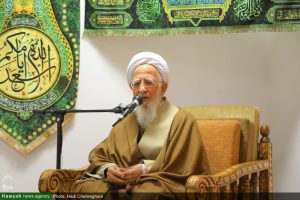
Hojatoleslam Sayyid Shahnshah Hussain Naqvi, head of the Jafariya Alliance of Pakistan, has stated that this year’s Muharram carries exceptional weight, as unfolding global events have directed the world’s attention toward the school of the Ahl al-Bayt (PBUT) more than ever before.
Addressing the “Mourning and Our Responsibility” conference in Karachi, Naqvi underscored the heavy responsibility now resting on the shoulders of orators, elegists, scholars, and mourners of Imam Hussein (PBUH).
“Muharram this year holds special significance,” Naqvi declared. “From the holy month of Ramadan until now, widespread developments and tensions have unfolded on the international stage. This very reality has caused the world’s gaze to turn increasingly toward the school of the Ahl al-Bayt (PBUT) and the Shia community.”
“In such circumstances, the duty of preachers, lamentation reciters, scholars, and Hussaini mourners is heavier than ever before. We must seize the opportunity of Muharram to correctly introduce the culture of Ashura, elucidate the teachings of the Ahl al-Bayt, and spread the message of truth-seeking and justice-seeking,” he added.
‘The Pulpit of Imam Hussein Must Become a Center for Unity’
The Jafariya Alliance chief stressed that the pulpit of Imam Hussein (PBUH) must be transformed into a hub for promoting the message of the Ashura uprising, the righteous conduct of the Ahl al-Bayt, the unity of the Islamic Ummah, and the defense of truth.
He further called on mourners and religious activists to avoid all forms of discord, tension, and behavior that could pave the way for division or be exploited by enemies. “If we succeed in conveying the message of Imam Hussein (PBUH) to the people correctly and take steps toward strengthening the unity of the Islamic Ummah, this will earn the pleasure of God Almighty, the Holy Prophet, and his purified household (PBUT),” Naqvi said.
Security, Coordination Top Agenda at Karachi Conference
The “Mourning and Our Responsibility” conference, organized by the Jafariya Alliance of Pakistan, brought together a broad spectrum of scholars, heads of mourning committees and religious organizations, trustees of mosques and Hussainiyas, directors of charitable and cultural institutions, and representatives of service groups.
The gathering saw the prominent participation of representatives from bodies including the Shia Ulema Council of Pakistan, Majlis-e-Wahdat-e-Muslimeen, the Central Mourning Organization, the Board of Imams and Shia Scholars, the Imamia Students Organization, the Imamia Organization, the Council of Imamia Elegists, the Amroha Sadat Association, the Khoja Ithna-Asheri Community, the Pak Muharram Association, the Payam-e-Wilayat Foundation, the Mourners Organization, the Jafariya Organization, and numerous other religious and social groups.
Participants exchanged views on existing challenges, needs, and practical solutions for organizing mourning gatherings and processions during Muharram. Proposals were put forward to enhance the quality of programs, improve coordination among various institutions, and ensure the safety of mourners.
Call for Full Security Measures
In a pointed appeal, Naqvi called for the adoption of comprehensive security measures to protect mourning gatherings and processions, urging state officials and security agencies to ensure the complete safety of mourners as in previous years.
“Determining the manner of holding mourning ceremonies, planning gatherings and processions, introducing and promoting the culture of mourning, and making decisions regarding the internal affairs of these ceremonies are the natural right of mourners and organizing bodies,” Naqvi asserted. “In return, the responsibility of the executive and law enforcement apparatus is to maintain security, uphold public order, and cooperate in logistical and service-related affairs connected to the mourning ceremonies.”
He concluded by expressing hope that through mutual cooperation between public institutions and government bodies, this year’s Muharram mourning ceremonies would, like previous years, be held in a secure, orderly, and magnificent atmosphere, allowing Hussaini mourners to perform their religious rites in complete peace and safety.