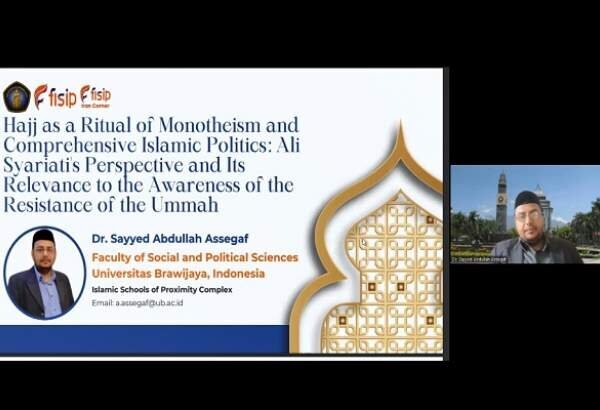
Sayyid Abdullah Isqaf, professor of West Asian studies and head of the Iran Desk at Brawijaya University in Indonesia, addressed the specialized forum “Hajj: Rendezvous of Unity,” held on Wednesday by the World Forum for Proximity of Islamic Schools of Thought. He explored how Dr. Ali Shariati understood Hajj not merely as a religious ritual, but as a powerful source of spiritual consciousness, social equality, political awareness, and resistance against oppression.
“Hajj is often viewed as an individual act of worship, a journey to the holy land, or a reenactment of the tradition of Prophet Ibrahim (PBUH),” he said. “Yet Ali Shariati offers a deeper interpretation and understanding. For him, Hajj is the heart of a comprehensive system of consciousness, linking spirituality with social responsibility and worship with historical struggle. Hajj is not an escape from the world. Rather, it is a process that transforms human beings. Through Hajj, the individual is invited to move from personal concerns to collective consciousness, from the self to submission, and from passivity toward responsibility. Hajj thus becomes a living manifestation of Tawhid — monotheism in action.”
He continued: “For Shariati, Tawhid is not merely belief in the oneness of God. It is also a worldview that rejects the separation between religion and life, between spirituality and politics, and between worship and justice. This meaning is visible in Hajj. When millions of pilgrims wear the same Ihram, social status vanishes. Wealth, race, nationality, and rank no longer define a person. All stand equal before God Almighty. This equality is not only symbolic but a critique of modern injustice, where people are often divided by class, power, and wealth. Through Tawhid, human beings are freed from submission to other human beings. One who submits only to God must not submit to tyranny, exploitation, or oppression.”
He stressed: “The next dimension is how we understand Hajj as submission and surrender. This important aspect of Hajj is complete submission to God. When pilgrims enter the Miqat to don the Ihram, they leave behind their old identities. Luxury, pride, social standing, and worldly ambition fall away. What remains is a human being as a servant of God. The Talbiyah is not merely a prayer; it is an existential declaration — ‘Here I am, O Lord.’ It means answering God’s call and rejecting submission to anything other than Him. From this perspective, Shariati reveals an important paradox: true freedom begins with submission to God. Only the one who submits to God alone will have the courage to resist false powers.”
Turning to sacrifice and the spirit of Prophet Ibrahim (PBUH), Isqaf stated: “Prophet Ibrahim is central to the meaning of Hajj. Shariati sees Ibrahim not only as a historical prophet but also as a revolutionary figure. Ibrahim left his homeland for the truth. He destroyed idols and challenged despotic authority. The sacrificial rite during Hajj also carries a deeper meaning; it is not merely about slaughtering an animal. It is about sacrificing the ego, fear, comfort, and personal attachments. Shariati says everyone has their own Ismail that must be sacrificed. This Ismail could be ambition, fear, wealth, power, or anything that obstructs obedience to God and commitment to justice.”
He then addressed the ritual of Ramy al-Jamarat and its symbolism of resistance, adding: “The ritual of stoning the Jamarat is commonly understood as the symbolic rejection of Satan, but Shariati expands this meaning. The Jamarat represent all the forces that divert humanity from the truth — including political tyranny, colonialism, exploitative capitalism, cultural domination, and injustice. Thus, Ramy al-Jamarat is not only a symbolic act but a declaration of resistance. A Muslim returning from Hajj must not remain a passive individual. Hajj must generate moral courage. It must produce individuals ready to confront oppression and to define truth within society.”
The West Asian studies professor continued: “The next aspect concerns Islamic political consciousness. Ali Shariati fiercely rejected the idea that religion should be separated from politics. For him, Islam is a religion of liberation. However, the politics of Hajj is not narrow politics like the competition for power. It is civilizational politics — the struggle to build justice, a dignified and free society based on defined values. Hajj brings together Muslims from numerous nations, languages, cultures, and social backgrounds, and these rites become a global space for dialogue and unity. It also reveals the idea of the Ummah — a community that transcends ethnic and national borders. Hajj reminds Muslims that they all share one direction, one history, and one responsibility.”
Isqaf noted that Shariati’s ideas had a profound impact on the intellectual and spiritual climate preceding Iran’s Islamic Revolution. Under the Shah’s regime, which was authoritarian and heavily aligned with Western powers, Shariati reinterpreted Islam for the younger generation. He presented Islam not as a passive religion but as a liberating ideology. His understanding of Hajj helped people see that worship could generate collective consciousness. The Muslim community was not merely a collection of individuals but a body capable of resisting tyranny. Shariati also linked the sacrifice of Prophet Ibrahim (PBUH) with the sacrifice of Imam Hussein (PBUH) at Karbala, emphasizing that resistance against injustice is not only a political act but a spiritual duty.
“Hajj has thus taught one of the greatest lessons of unity,” he said. “Millions of Muslims gather regardless of race, gender, language, nationality, or social class. But this unity does not mean uniformity, nor does it erase diversity. Instead, it creates a shared orientation toward Tawhid. For Shariati, the real problem of the Muslim community is not difference itself. The real problem is the failure to build collective consciousness.”
Isqaf asserted: “Hajj also teaches resistance. Islam does not encourage passive acceptance of oppression. The history of the prophets bears witness to a continuous struggle against tyranny. Therefore, a true understanding of Hajj must lead to a moral commitment to the oppressed and the marginalized. We live in a world beset by war, poverty, economic inequality, Islamophobia, moral crisis, and cultural domination. In this context, Hajj offers important lessons. First, it teaches simplicity amid consumerism. Second, it teaches solidarity amid individualism. Third, it teaches equality amid global injustice. Hajj reminds humanity not to become slaves to materialism, wealth, or power. If properly understood, Hajj becomes a source of moral awakening and civilizational renewal for the Islamic world.”
The Indonesian academic concluded: “Hajj is not merely a physical journey to the Kaaba but a journey toward consciousness. Through Hajj, Muslims are reminded of Tawhid, equality, sacrifice, responsibility, unity, and resistance to oppression. From Shariati’s perspective, Hajj transforms worship into social power. It links faith with justice, spirituality with courage, and ritual with transformation. The deepest meaning of Hajj is liberation — liberation from the ego, from false identities, from tyranny, and from every form of submission except submission to God Almighty. The challenge for Muslims today, therefore, is to understand Hajj not only as a formal ritual but as a living source of consciousness, unity, and resistance.”