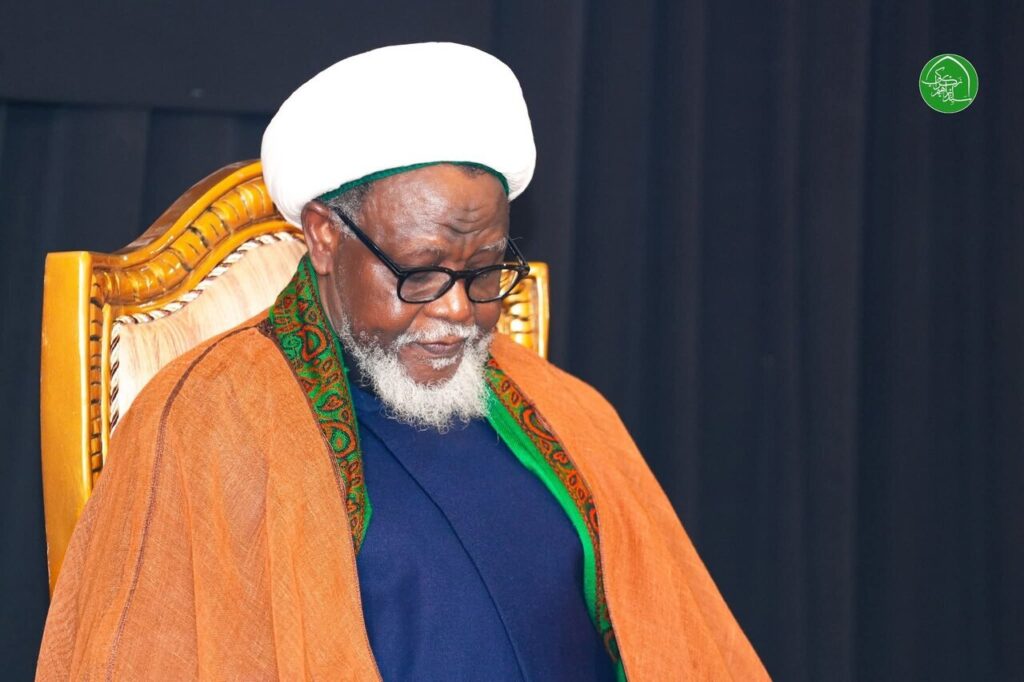
In his message, Sheikh Zakzaky stated that the past forty days have served to illuminate the profound station of “Sayyed Khamenei.” He noted that the global outpouring of grief has proven the late Leader was not merely a political figure who could be eliminated through physical means, but rather a “resolute school of thought and a character deeply embedded in the hearts of the people.”
The cleric pointed out the enemy’s failed assumption that the Islamic establishment would collapse within days of such an attack. “They imagined the people would take to the streets in joy, as if a burden had been lifted,” the message read. “Instead, the world witnessed the opposite. The people demonstrated that Seyyed Ali Khamenei was like a father to this Ummah.”
Sheikh Zakzaky further addressed the swift and seamless transition of leadership to Seyyed Mojtaba Khamenei, describing it as a divine reply to the arrogance of the aggressors. He emphasized that the new Leader is a continuation of the same bloodline and the same unwavering path of resistance—a figure whose family has been targeted by terrorism, yet whose resolve remains unshaken by the enemy’s conspiracies.
Turning to the geopolitical front, the Nigerian leader delivered a stark warning regarding the strategic waterways of the region. “You must know that the Strait of Hormuz and Bab el-Mandeb are not ungoverned territories,” Sheikh Zakzaky stated. “The Strait of Hormuz belongs to the Iranian nation, and Bab el-Mandeb lies within the sphere of Yemen. This is among the wisdoms of the Almighty. Those who wish to navigate these passages must respect the rights of their sovereigns.”
The message concluded by labeling the adversaries as “paper tigers,” whose military might have been exposed before the power of divine will. “You sought to extinguish a light,” Sheikh Zakzaky asserted, “but Allah has made it burn brighter. You have only succeeded in unveiling your true nature to the global populace.”
He concluded with prayers for the victory of the Islamic Republic, the new Leader Seyyed Mojtaba Khamenei, and the Axis of Resistance from Lebanon to Palestine and Yemen.