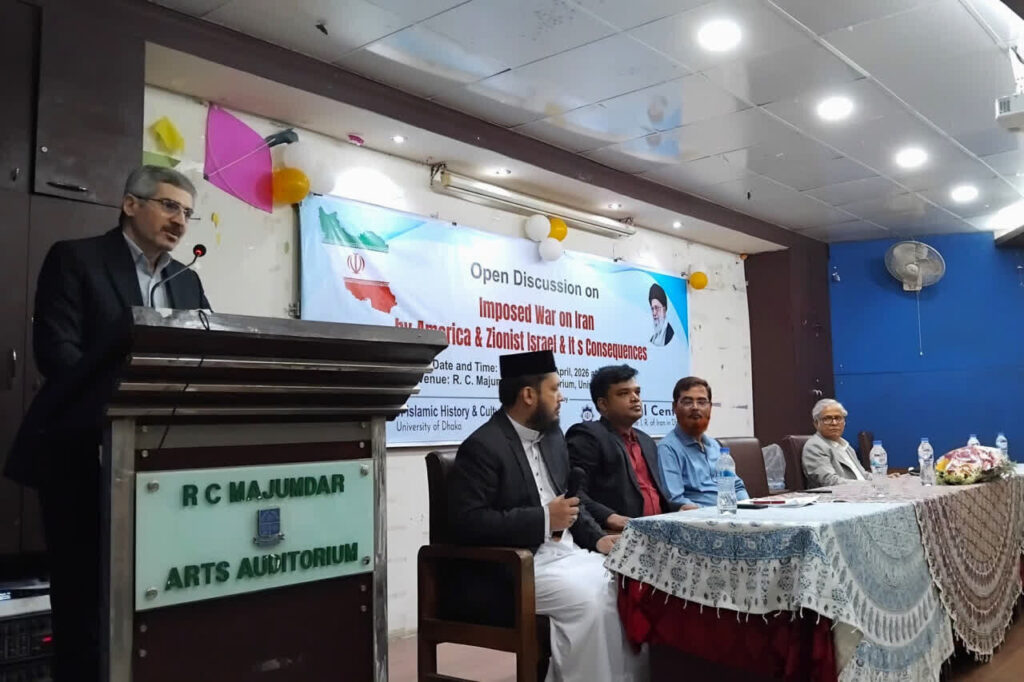
The comments came during a conference titled “The US-Zionist Regime’s Imposed War on Iran and Its Consequences,” organized by the Iranian Cultural Office in Bangladesh in collaboration with the Department of Islamic History and Culture at the Faculty of Humanities, University of Dhaka.
Held at the university’s premises, the event brought together academics, researchers, and students to analyze the multidimensional impact of the “Ramadan War”—the full-scale military aggression launched by the United States and the Israeli regime against Iran.
In his address, the Iranian cultural attaché in Bangladesh emphasized that the Islamic Republic has successfully presented a new paradigm of Islamic governance based on spirituality, justice, and resistance against arrogance. He noted that despite decades of sanctions, military threats, and propaganda warfare, Iran’s model continues to inspire oppressed nations around the world.
Speakers at the conference highlighted that the imposed war was not merely a military confrontation but an all-out assault on the values of the Islamic Revolution, including calls for regional independence, support for the Palestinian cause, and rejection of foreign domination.
The gathering also condemned the role of Western media in distorting the narrative of the war and attempting to portray Iran’s defensive actions as acts of aggression. Scholars stressed that the Iranian nation’s steadfastness in the face of the US-Israeli onslaught has reshaped power equations in West Asia and exposed the hollow claims of Western-backed human rights organizations.
Faculty members from the University of Dhaka praised Iran’s resistance as a source of inspiration for Muslim-majority nations, particularly in defending sovereignty against external interference. They called for stronger academic and cultural exchanges between Iran and Bangladesh to further explore the political, historical, and theological dimensions of the imposed war.
The event concluded with a call for Muslim nations to unite against common enemies and to draw lessons from Iran’s experience in confronting what was described as the most sophisticated military machine backed by the US and the Zionist entity.
The conference is part of a broader initiative by the Iranian Cultural Office in Bangladesh to deepen mutual understanding and build intellectual solidarity among scholars and youth on critical issues facing the Islamic world today.