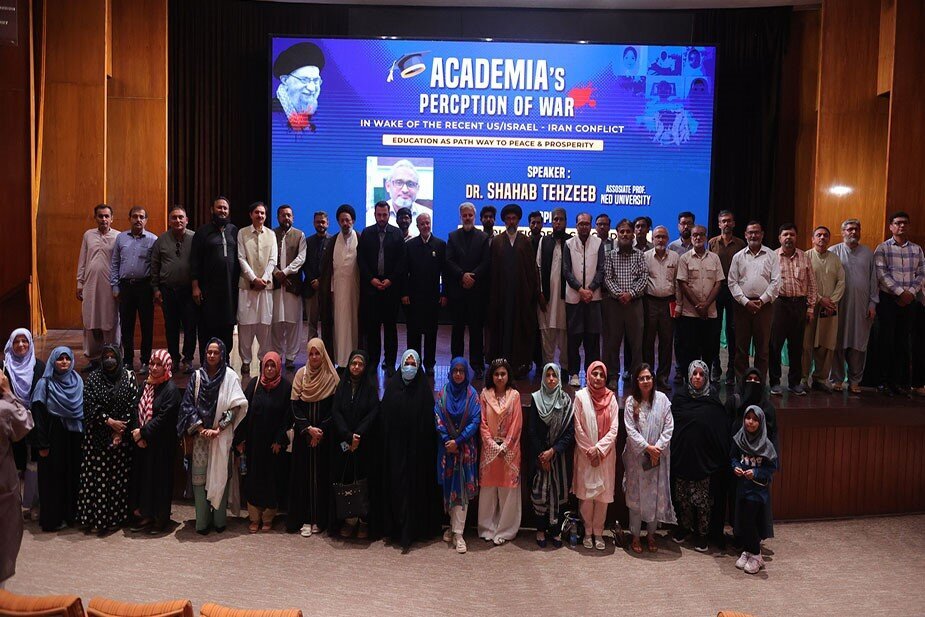
The seminar, “The Iran-US War from an Academic Perspective,” brought together university professors, scholars, and students at the NED University of Engineering and Technology in the port city of Karachi.
Addressing the gathering, former Pakistani Finance Minister Miftah Ismail stated that in the imposed war during the month of Ramadan, the greatest losses have been suffered by the United States and Israel.
He went on to note that Iran has faced continuous sanctions ever since the Islamic Revolution, but should an agreement be reached, the Iranian economy will grow rapidly. He added that the coming six months will be difficult for Pakistan, yet with the lifting of sanctions on Iran, Pakistan too will stand to benefit from this new situation.
The Pakistani researcher asserted, “If we examine the scale of the damage inflicted, Israel has sustained the heaviest losses. And since the Islamic Revolution, Iran has been under constant sanctions, but in the event of an agreement, it will emerge as one of the major powers in the Persian Gulf region.”
He further highlighted that bringing down an Iranian drone worth 20,000 dollars has cost an estimated 200 million dollars. Moreover, the 60-trillion-dollar American market has suffered a collapse, and according to public opinion, there is a likelihood that the Republican Party, led by Donald Trump, will face defeat in the November elections. He added that while Iran’s human casualties have not been irreparable, the ultimate outcomes of this war will work in Iran’s favor.
Miftah Ismail also remarked that with the removal of sanctions, the Iran-Pakistan gas pipeline project would gain renewed momentum, bringing considerable benefit to Pakistan. Beyond this, he said, Islamic Iran could emerge as a major commercial market for Pakistan.
A special feature of the ceremony was the presence of the “Under the Shade of the Sun” caravan, bearing the sacred flag of the Holy Shrine of Imam Reza (PBUH), which lent a deeply spiritual atmosphere to the event. Attendees also voiced their solidarity in protest against the policies of the United States and Israel.
It is worth noting that the program was chaired by Dr. Ghazanfar Hussain, head of the university’s Registration and Academic Records Department, while Dr. Saeed Talebinia, Director-General of the Cultural Center of the Islamic Republic of Iran in Karachi, attended as the distinguished guest of honor.