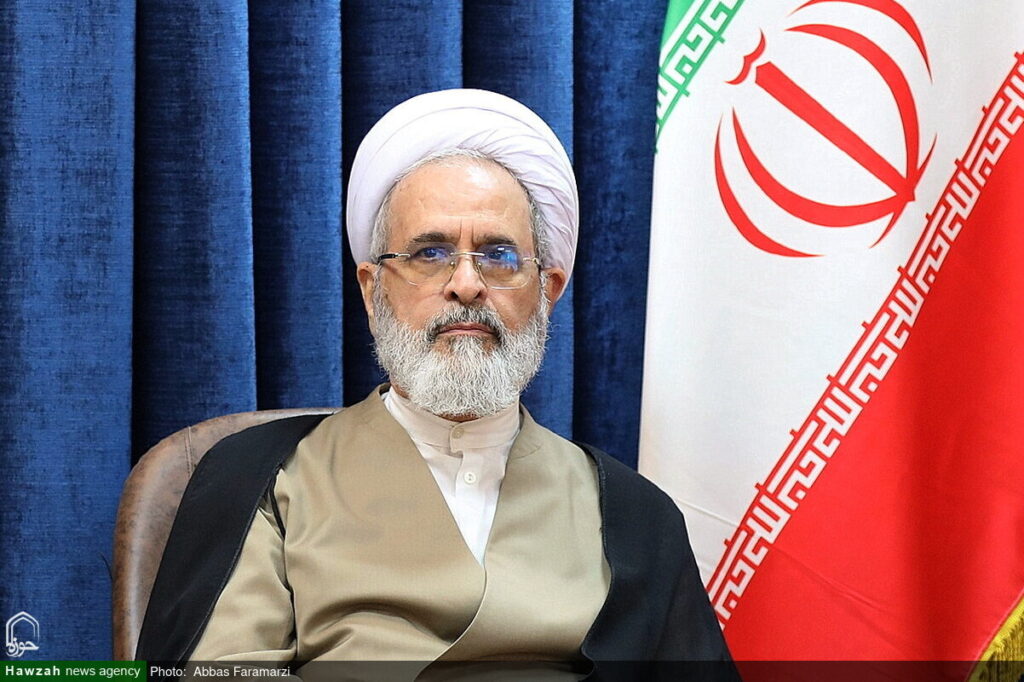
In a comprehensive and analytical statement, the senior cleric outlined the path forward for officials, clergy, and the masses, framing the current geopolitical standoff not merely as a territorial conflict but as a decisive battle against a coalition of American and Zionist arrogance.
The Failure of “Operation Freedom”
Ayatollah Arafi pointed to the enemy’s recent launch of “Operation Freedom,” a U.S.-led attempt to break the impasse over the vital Strait of Hormuz, as a testament to the failure of Western military and diplomatic strategy. According to the statement, the operation collapsed within its first 48 hours under the “crushing blows” of Iran’s Armed Forces.
“Closing the Strait of Hormuz is, in effect, closing the economic artery of the West and the United States,” the statement read, noting that American efforts to force a reopening have remained futile. With his military option blunted, the U.S. President finds himself confined to a trilemma: accepting Tehran’s conditions—a move Ayatollah Arafi equates with the collapse of American superpower status; attempting to extract concessions through deceptive diplomacy; or launching desperate strikes against Iranian infrastructure while relying on a massive propaganda campaign to fabricate a narrative of victory.
No Retreat: The Red Line
Central to the cleric’s strategic doctrine is the absolute rejection of retreat. Citing Quranic injunctions against obeying “disbelievers and hypocrites,” Ayatollah Arafi stressed that even a single step backward is the beginning of a slippery slope toward capitulation.
“The Strait of Hormuz is not merely an international waterway; it is the vital artery of our national security and our strategic red line,” the statement emphasized. “Any retreat on this point is equivalent to handing the keys to Iran’s economy and security to the enemy.”
The statement asserted unequivocally that the waterway will remain under the absolute sovereignty and management of the Islamic Republic’s armed forces, dismissing any foreign authority or deceptive agreement that seeks to cross this red line.
The Cleric’s Six-Point Strategy for the Home Front
Ayatollah Arafi moved beyond military analysis to mobilize the nation’s cultural and economic fortresses, issuing a six-part directive to the clergy and the people:
- The Jihad of Clarification and Hope: The enemy seeks to impose a “gradual retreat” on Iran—first on the battlefield, then in diplomacy, and finally in the hearts and minds of the people. The clergy are tasked with neutralizing psychological warfare by bolstering national unity and the spirit of resistance through Quranic principles.
- Demanding Honorable Diplomacy: Warning against a “deceptive ceasefire,” Ayatollah Arafi declared that any diplomacy must be rooted in authority and the consolidation of battlefield gains. He asserted that no negotiations are acceptable if they ignore Iran’s field victories or seek to dismantle its defense architecture.
- Economic Jihad and Unity: Addressing mounting economic pressures, the statement identified three roots of inflation: the implementation of capitalist economic thought, cruel external sanctions, and internal profiteering through hoarding. The cleric called for a public movement to monitor and expose economic corruption, promote austerity over extravagance, and demand the full implementation of a “Resistance Economy” by government bodies.
- Cultural Warfare and Social Cohesion: The enemy’s media octopus seeks to create a dual-polarity within society. While affirming the hijab as a religious and political necessity, Ayatollah Arafi urged the clergy to use this moment for positive engagement and attraction, rather than allowing the issue to become a source of social division exploited by hostile media.
- National All-Out Jihad: In the “post-ceasefire” reconstruction era, all sectors—from industry and agriculture to science and civil defense—must operate under a mobilization logic. The statement demands a public jihad by both officials and the elite to overcome structural weaknesses.
- The Mahdavi Horizon: The statement concludes by framing the resistance not just as a nationalist struggle, but as a civilizational duty to pave the way for the advent of Imam Mahdi (PBUH). It defines the modern American empire as the “Sufyani of the End Times,” asserting that steadfastness on this front is a direct exercise in preparing for the global government of divine justice.
“In this battle, the enemy suffers as we suffer, but we hope in God for what they do not hope,” the statement concluded, quoting the Holy Quran. “Victory comes only from God, the Almighty, the All-Wise.”