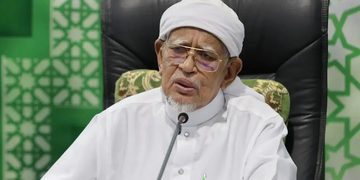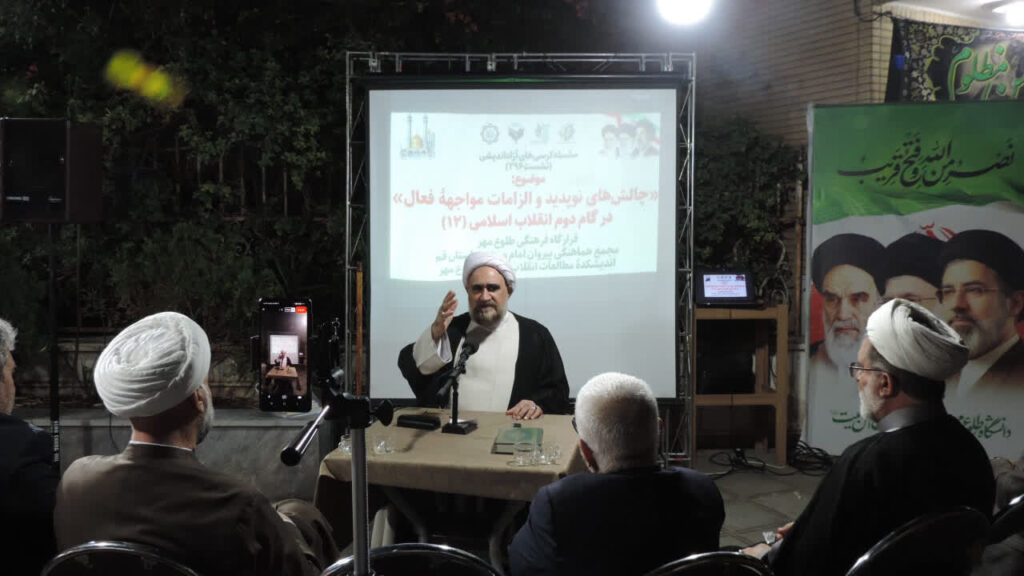
Speaking at the 296th session of the Free-Thinking Chairs forum in Qom, Hojatoleslam Mohsen Mohajerinia, head of the Tolu-e Mehr Institute for Islamic Revolution Studies, laid out a sweeping analysis of the modern challenges facing Iran and the active counter-measures required in the second phase of the Islamic Revolution.
The Nature of Modern Hybrid Warfare
Mohajerinia characterized contemporary threats by their speed of dissemination, complexity, deep entanglement with emerging technologies, and their direct targeting of national identities. He argued that challenges become potent only when an external enemy weaponizes internal vulnerabilities to orchestrate a full-spectrum hybrid war against the nation.
Referencing the foreign-fomented “Woman, Life, Freedom” disturbances, the analyst pointed to explicit confessions by American and Zionist officials. “Their goal was never to resolve the nuclear dossier or address human rights,” Mohajerinia stated. “Their explicit objective was the complete collapse of Iran—the termination of a country whose entire policy framework is anti-colonial. Through intelligent defense, we not only thwarted this objective but gained unprecedented strategic achievements.”
Geopolitics Reforged: The Hormuz Factor
Central to the thinker’s thesis is the shifting geopolitics of the Strait of Hormuz. He described the waterway as a divine gift and a lever of national power firmly in Iran’s grip.
“In the past, superpowers sailed their fleets through Hormuz without a second thought. Today, the United States requires desperate coalition-building with Western allies just to posture against Iran in these waters,” Mohajerinia noted. He highlighted that even traditional European powers like France are actively avoiding entanglement in America’s Hormuz brinkmanship, marking a definitive shattering of Western hegemony.
“From the ashes of WWII, a few victorious states granted themselves veto power and carved up the world. Iran is the first nation to fundamentally challenge this rigged structure,” he asserted. “Today, the gravitational pull of the Islamic Revolution is so strong that powers like China and Russia have tied their own futures to Iran, going so far as to wield the veto in the Security Council in our favor.”
Homegrown Power and the Death of Sanctions
The scholar ridiculed the failure of the Western economic siege, highlighting Iran’s domestic military advancements. “Our indigenous drone program—built entirely under sanctions—has reached a point where traditional global powers boast about its capabilities in their own strategic calculations. This signifies the absolute failure of America’s decades-long policy of keeping Iran weak.”
Economically, Mohajerinia stated that the strategy of strangulation has backfired on the White House. “Today, contrary to the era of the Iran-Iraq war, we are not isolated. Iran exports its oil with full authority—without the demeaning discounts of the past, and under wartime conditions. The economic targeting of Tehran has collapsed. It is America that is sinking into international isolation, having fled from international institutions and the JCPOA in a failed attempt to project strength.”
Narrative Warfare and Smart Governance
The strategist concluded by framing the current battle as a “war of narratives,” where presenting the first and truthful account to public opinion is the paramount condition of power. He called for a rapid upgrade in media literacy and analytical capability among the populace to counter Western disinformation machinery.
Echoing the intellectual legacy of the late Dr. Ali Larijani, Hojatoleslam Mohajerinia underscored that the ultimate requirement of the current era is the realization of “smart governance.” “The government and the nation must move forward shoulder-to-shoulder on the basis of ‘governance of stability and rationality,'” he said. “Only this formula insures the country against modern shocks and crises.”