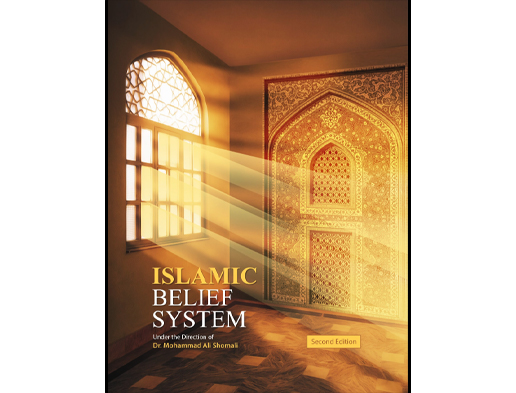
Islamic Belief System is a research-based and educational work in the field of Islamic theology and beliefs, written with the aim of systematically elucidating the foundational principles of Islam. Published under the supervision of Dr. Mohammad Ali Shomali, this book seeks to present Islamic beliefs not in a scattered manner, but as a coherent, purposeful, and harmonious “system,” while revealing their role in shaping a religious worldview and lifestyle. The book employs a combined approach of rational and scriptural arguments, striving to address humanity’s fundamental questions while explaining the role of religious beliefs in achieving individual and social felicity in this world and the hereafter. With its orderly structure and fluent language, the work is designed for a wide range of readers interested in the intellectual foundations of Islam.
The book begins with a foreword, introduction, and user guide, followed by six main sections that progressively lead the reader from the knowledge of God to the knowledge of felicity.
The first section, entitled “Our Beautiful World,” offers an introduction to the knowledge of God through reflection on nature. This section prepares the reader for the main discussions by contemplating the wonders of the universe. It then examines in detail the classical proofs for the existence of God—those based on design, fitrah (innate disposition), possibility and necessity—while presenting the views of various thinkers on these matters.
After establishing the existence of God, the book addresses His affirmative and negative attributes. This section explains the ways of knowing God’s attributes, His attributes of beauty and majesty, and His most important attributes, including eternity (past and future), knowledge, power, and divine wisdom. It then discusses the relationship between divine wisdom and the problem of evil, analyzing the philosophy of evil’s existence in the world. The chapter “The Relationship Between God and Creatures” is devoted to divine lordship, the oneness of worship, and the concept of polytheism (shirk).
Another significant section of the book addresses the body and soul, as well as the theory of evolution. This part first presents scientific evidence and rational arguments to prove the existence of the soul. It then critically examines Darwin’s theory of evolution, referencing the views of biologists and Abrahamic faiths on the matter. The section “Characteristics of Human Beings” deals with the nature of humanity, human self-ownership, human dignity and worth, freedom, security, equality, and the perspective of religions on human inclinations. It continues with discussions of divine justice, racial and gender discrimination, and Islam’s view on the value and rights of women.
A substantial portion of the book is dedicated to guidance and prophethood. It first elucidates the levels of general and special guidance and their instruments (fitrah, reason, and revelation). It then examines the characteristics of prophets, including their number, infallibility, iron will, divinely bestowed knowledge, and more. The personality and attributes of the Noble Prophet (peace be upon him)—including his ethics, trustworthiness, worship, simple living, struggle against oppression, and his mission—are elaborated. The inimitability (i’jaz) of the Qurʾān, with reference to its linguistic, substantive, and scientific dimensions, along with the finality of prophethood and the Shiʿa and Sunni views on the Prophet’s succession, are among the key topics of this section.
The final section of the book addresses the hereafter and eternal abode, followed by individual and social felicity. It begins with rational and justice-based proofs for the resurrection, along with explanations of the nature of death and the intermediary realm (barzakh). It then discusses the features of the Day of Judgment, Paradise and Hell, and the matter of intercession.
Finally, the concept of individual felicity—emphasizing self-knowledge, proximity to God, tranquility, and gnosis—is outlined, alongside social felicity through depicting the characteristics of the ideal Islamic society, including its identity, economy, and security, as the ultimate fruit and goal of the Islamic belief system.
Islamic Belief System goes beyond merely teaching doctrinal principles; it demonstrates the vital role of these beliefs in organizing individual and social life. The book’s primary mission is to provide a coherent framework for the Islamic belief system that can both answer humanity’s fundamental questions about existence and creation and serve as the foundation for forming ethics and righteous action within a harmonious intellectual framework. Those interested in learning more about this work can access its electronic version at:https://shomali.net/flipbook/islamic-belief-system/
The book has also been authored in six other languages, including farsi , Arabic, Italian, Urdu, Spanish, and Thai.