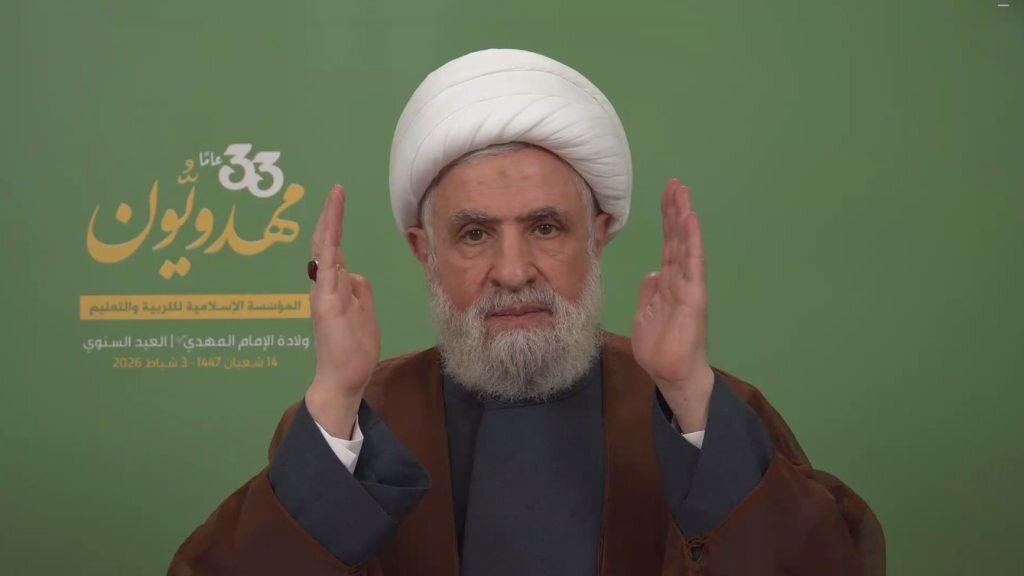
Hezbollah Secretary-General Sheikh Naim Qassem said on Tuesday that the party is in a phase of defending the land, existence, and liberation. Pointing out that the Israeli occupation wants to strike the resistance environment to intimidate it and push it to surrender, and that it is using the pretext of neutralizing Hezbollah’s military arsenal, but what it actually wants is to “neutralize our existence”.
He added that the resistance’s position remains rooted in defense, emphasizing that the battle imposed on Lebanon is not one of choice, but of necessity.
During his speech on the occasion of the blessed 15th of Shaaban, Sheikh Qassem emphasized that Israeli targeting is directed at the entire homeland, not a single party or group. He stressed that confronting this aggression is anational responsibility that falls on all Lebanese, warning against attempts to fragment the domestic front.
“Those who stand with the enemy to push us toward surrender are not acting from a patriotic position”, he said, criticizing voices that align themselves with external pressure rather than national interests. Sheikh Qassem underscored that the scale and nature of the Israeli attacks leave no room for ambiguity about their broader implications for Lebanon as a whole.
Sheikh Qassem affirmed Hezbollah’s readiness for dialogue, stating: “We are ready to discuss how to repel the aggression with those who believe in this approach”.
Addressing Lebanese officials involved in negotiations, he urged them to reject US and Israeli attempts to pressure the Lebanese public, saying: “explain to them that you cannot pressure the people of your country because they have made many sacrifices”.
He added that Lebanon is no longer required to take any action regarding implementation of the ceasefire agreement, shifting responsibility away from Beirut. Instead, he said, the Quintet Committee must demand that “Israel” fulfill its obligations under the ceasefire agreement, rather than placing political and diplomatic pressure on Lebanon.
The Secretary-General of Hezbollah framed the confrontation within a broader geopolitical context, warning of unfettered American domination. “We are facing American hegemony that transcends the world,” Sheikh Qassem said, asking whether such hegemony, which infringes on the rights of nations, should be resisted or accepted.
He reiterated that Hezbollah’s stance is clear: “Our position is to defend ourselves, not to surrender”. He added that “those who have the will, faith, right, and sovereignty can achieve their goals, and the enemy cannot take our land,” stressing that deterrence remains effective.
“Just as the enemy hurts us, we can hurt them, and everything will happen in due time”, he said.
Sheikh Qassem noted that the presence of Hezbollah, the Amal Movement, other national forces, and the Lebanese army, representing all segments of the nation, is a significant asset with the capacity to achieve liberation.
On internal Lebanese affairs, he recalled that Hezbollah and the Amal Movement elected President Joseph Aoun of their own volition, and that their ministers are working in the interest of all Lebanon. In direct contrast with other ministers within the government who are “dragging the country toward strife”, accusing them of undermining stability.
Sheikh Qassem also noted that Hezbollah and the Amal Movement helped preserve the country’s “fragile order” by voting in favor of the budget, and reiterated support for holding elections in accordance with the law.
Beyond Lebanon, he described Iran as “the crown jewel of the world” and will endure, asserting that it is capable of defeating the United States and “Israel”.
Sheikh Qassem’s remarks come amid continued Israeli aggressions across various regions of Lebanon, particularly in the south, alongside the occupation of Lebanese territory along the border with occupied Palestine and the detention of at least 24 Lebanese in Israeli prisons.
They also come as Lebanon awaits parliamentary elections scheduled for May, amid debate over a possible postponement and ongoing discussions surrounding the electoral law, particularly with regard to expatriate voting.