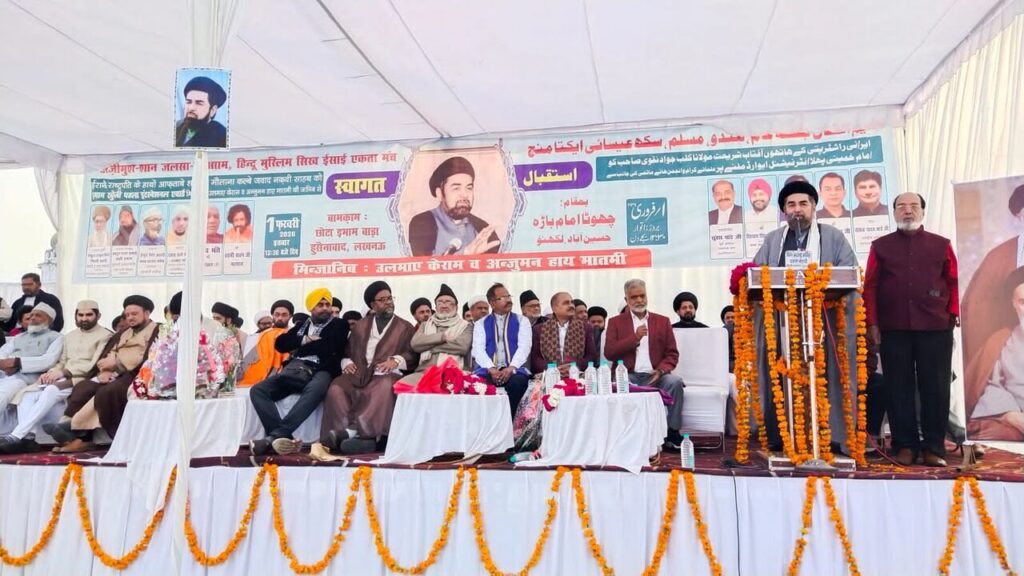
The call was made during a ceremony in Lucknow marking the award of the Imam Khomeini (RA) International Prize to Hojatoleslam Syed Kalbe Jawad Naqvi, Secretary General of the All India Shia Personal Law Board and Friday prayer leader of Lucknow. The event was organized with the participation of religious associations and the Hindu–Muslim–Sikh–Christian Unity Forum, and was attended by political, religious, and social figures.
Participants congratulated Naqvi on the honor, thanked the Iranian government for the award, and emphasized the need to expand friendly relations between India and Iran. They also voiced support for Iran’s Islamic Revolution and Ayatollah Seyyed Ali Khamenei, Leader of the Islamic Revolution, while strongly condemning the policies of the United States and the Israeli regime. Several speakers criticized sections of the Indian media for biased and unfair portrayals of Iran and its leadership.
Addressing the gathering, Swami Sarang said the ceremony honored not merely an individual but a figure whose lasting services have had a broad social impact. Referring to the message of Karbala, he said oppression—regardless of its power—cannot withstand patience and resistance, adding that Iran today stands on this very path.
Nitendra Yadav, national spokesperson of the Samajwadi Party, said India can only serve as a “global model” if it respects all religions, stressing that extremism in any faith does not produce peace. Ashok Singh of the Indian National Congress described the award as a source of pride for Lucknow and India, noting that Naqvi and his family have long championed unity and social cohesion.
Preeti Pal Singh, spokesperson for the Aam Aadmi Party, underlined the importance of brotherhood and peaceful coexistence, recalling the collective role of all religions in India’s freedom struggle. Criticizing Washington’s policies, he said the Indian public does not support US and Israeli actions, condemning unilateral US tariffs against India and calling for closer ties with Iran and resistance to imposed policies.
Former Lucknow Bar Council president Suresh Pandey said the award symbolizes the deep historical bonds between India and Iran, urging renewed commitment to interfaith harmony and national unity.
Calling for improved relations between New Delhi and Tehran, Maulvi Fazl Manan Waizi, imam of Teele Wali Mosque, said the honor belongs to the entire nation and stressed that expanding ties with Iran serves India’s national and regional interests. He also warned against rising religious tensions in the country.
Buddhist leader Pujya Bhanteji Shri Dipankar Ji said present-day divisions stem from distancing from shared human values, urging an end to hate-based discourse as a prerequisite for progress and development.
Speaking on regional and global dynamics, Indian cleric Hojatoleslam Reza Haider Zaidi said major powers have historically sought domination over weaker nations, adding that the establishment of Iran’s system of Wilayat al-Faqih under Imam Khomeini (RA) was rooted in justice and independence. He argued that current pressures are aimed not at Iran’s destruction, but at undermining this system, and praised India’s supportive stance toward Iran at the United Nations.
In his address, Syed Kalbe Jawad Naqvi thanked attendees and organizers and expressed gratitude to Iran for awarding the prize. He called on the Indian government to further strengthen its longstanding ties with Iran, saying closer relations would benefit both nations and contribute to regional peace and stability.
Naqvi also addressed misconceptions about Islam, rejecting distorted interpretations of jihad as violence. He said jihad means striving for constructive and righteous causes, including education, combating ignorance, and serving society.
Criticizing US interventionist policies, he said Washington’s unpredictable actions have fueled global insecurity, adding that history shows powerful states are often defeated by determined nations. He warned that hostility toward religious authority extends beyond Iran to sacred centers in Qom, Mashhad, Najaf, and Karbala, noting the pivotal role of religious leadership—particularly that of Ayatollah Seyyed Ali al-Sistani—in defeating extremism in Iraq.
Naqvi also denounced hostile media narratives, saying true strength lies not in shelters but in mosques, husseiniyas, and religious centers. He urged greater awareness of Zionist ideology and called on nations and communities to make informed moral choices.
The ceremony concluded with chants in support of Iran and its leadership and denunciations of US and Israeli policies.