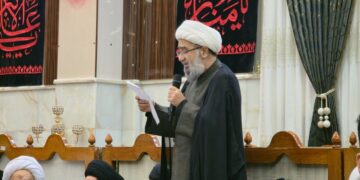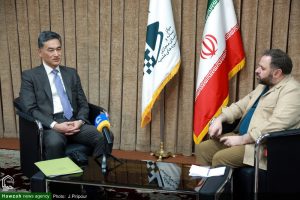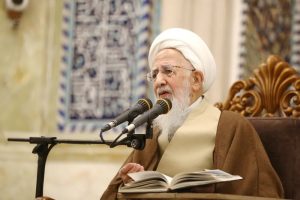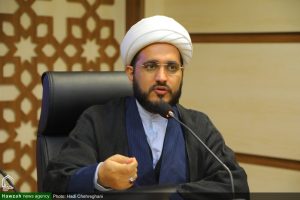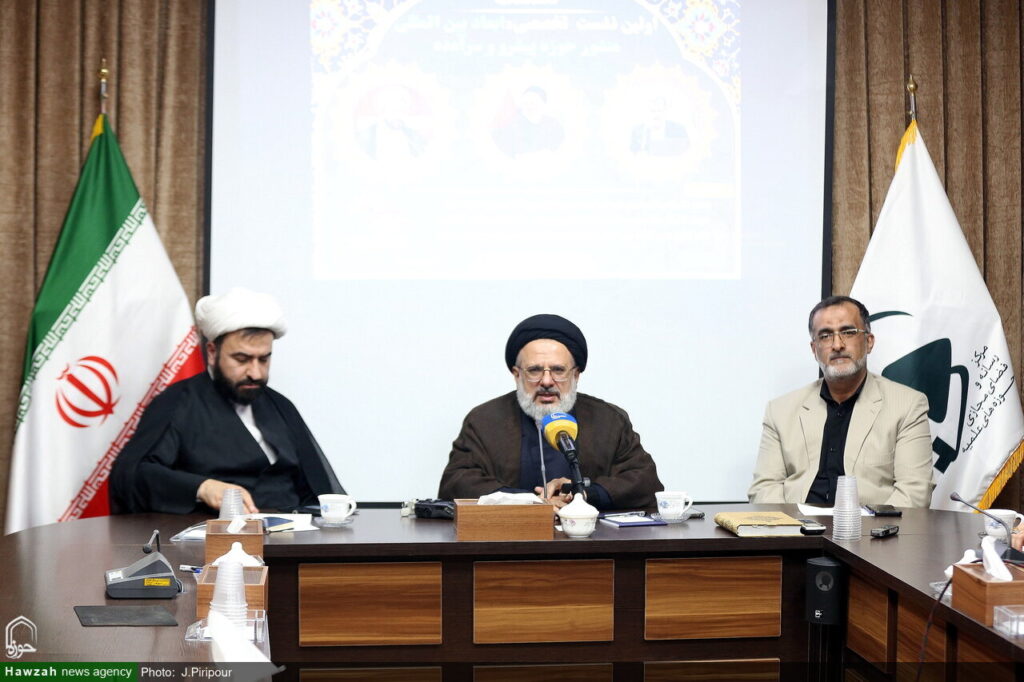
the conference took place on the evening of Sunday, May 17, 2026, organized by the Pioneering and Preeminent Seminary Headquarters of the Islamic Seminary Management Center at the Media and Cyberspace Center of the Islamic Seminaries. The event featured presentations and analyses by Hojatoleslam Seyyed Mofid Hosseini Kouhsari, Deputy for International Affairs of the Islamic Seminaries; Hojatoleslam Abedi Nejad, Research Deputy at Al-Mustafa International University; and Dr. Alireza Naeij, Director of the International Committee at the Research Institute for Seminary Leadership Studies, who shared their perspectives on the international dimensions of the “Pioneering and Preeminent Seminary Charter.”
The Pioneering and Preeminent Seminary Charter: A Roadmap for the Civilizational and Global Presence of Islamic Seminaries
In his opening remarks, Hojatoleslam Hosseini Kouhsari noted the anniversary of the historic message of the martyred Leader of the Islamic Revolution on the “Pioneering and Preeminent Seminary,” describing it as the source of significant transformations across various seminary domains. He stated: “This charter holds special importance from multiple perspectives, and in addition to its scientific, educational, pedagogical, social, and political dimensions, it also possesses prominent international aspects.”
He revealed that analyses show more than 150 expressions and keywords related to global issues and matters beyond Iran’s geographical borders appear in the charter’s text, adding: “Terms such as colonialism, global arrogance, the Zionist regime, Britain, the Islamic world, the Najaf Seminary, and influential figures of the Muslim world all reflect the international outlook governing this strategic document.”
The Deputy for International Affairs of the Islamic Seminaries noted that over the past year, numerous conferences and programs on the international dimensions of this charter have been held across Islamic seminaries, Al-Mustafa International University, and in several Islamic countries, including Iraq, Lebanon, Afghanistan, and India. However, he stressed that there remains a pressing need to revisit this message and elucidate its requirements.
He stated that the Pioneering and Preeminent Seminary Charter can be studied at three levels—the “text,” the “meta-text,” and the “strategic reading”—asserting that serious international messages exist within the explicit text of the message, the implicit requirements and obligations it contains, and the strategic outlook that can be extracted from this document.
Referring to the five identity-shaping pillars of the Islamic seminary outlined in the charter, Hojatoleslam Hosseini Kouhsari said: “The martyred Leader of the Revolution articulates two of the five pillars entirely through a global and international lens: first, the Islamic seminary as the frontline of confrontation with the system of domination and global arrogance, and second, the issue of forging a new Islamic civilization within the framework of Islam’s universal message, which is described as ‘the most prominent expectation of the Islamic seminaries.'”
He emphasized that the charter presents the Islamic seminary not merely as an educational or proselytizing institution, but as a transformative and influential center on the global stage, an institution whose mission is defined along the continuum of the mission of the Prophets and the Islamic Revolution.
The Deputy for International Affairs of the Islamic Seminaries stressed the need for transformation in the scientific, missionary, and civilizational arenas of the seminaries, saying: “The Islamic seminaries must achieve scientific authority at the global level, produce scholarly work commensurate with newly emerging global needs, and engage critically with the frontiers of global knowledge.”
He added that civilization-building jurisprudence, civilization-building humanities, and an Ummah-centric approach to religious knowledge are among the axes that must be prioritized in realizing the international dimensions of the charter.
Hojatoleslam Hosseini Kouhsari also underscored the necessity of training cultural combatants at a global standard, intelligently countering soft warfare, and strengthening seminary diplomacy, stating: “The Islamic seminary must be capable of presenting Islamic models on a global scale in the fields of system-building and theorization.”
In another segment of his address, pointing to global and regional developments, he described the martyrdom of the Leader of the Islamic Revolution as the catalyst for an international awakening, adding: “Today, the world is witnessing the gradual collapse of the domination system, the decline of the Zionist regime, and the formation of a new global order, conditions that further intensify the responsibility of the Islamic seminaries.”
The Deputy for International Affairs of the Islamic Seminaries also highlighted certain transformative measures undertaken by the seminaries in recent years, including the creation of strategic task forces for major national issues, the formation of structures for seminary-state interaction, the expansion of specialized preaching in the education sector and universities, and the design of mechanisms to address the intellectual and epistemological needs of the system.
He noted: “Despite all these measures, we are still at the beginning of the path, and achieving the ideal of a new Islamic civilization requires a more serious resolve, a discursive transformation, and a movement grounded in selfless struggle.”
The Seminary’s Mission Has Transcended Admonition, Reaching a Global Mission of Establishing the Faith
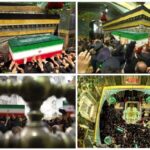
Following this, Hojatoleslam Abedi Nejad, Research Deputy at Al-Mustafa International University, addressed the conference, describing the massive public presence following the martyrdom of the Leader of the Islamic Revolution as a global awakening and a sign of a human renaissance on an international scale.
He stated: “The shattering of the global arrogance’s aura of invincibility and the formation of a wave of awakening among nations is a reality that has emerged through the blessings of the martyrs’ blood and the steadfastness of the Iranian nation, paving the way for the radiance of truth across the world.”
Stressing the necessity of revisiting the fundamental mission of the Islamic seminaries, Hojatoleslam Abedi Nejad remarked: “A proper understanding of the seminaries’ international mission is contingent upon a correct comprehension of their principal mission.”
Pointing to the paradigm shift in the perception of the seminary following the victory of the Islamic Revolution, he stated: “With the vision of Imam Khomeini, the mission of the Islamic seminaries became intertwined with the mission of the Prophets, transforming the seminary from a purely educational and admonitory institution into an institution for the establishment and proclamation of the faith on a global scale.”
Citing verses from the Holy Quran, the Research Deputy of Al-Mustafa University asserted: “The mission of the Islamic seminaries is the establishment of the faith and the global proclamation of Islam, a mission that naturally brings it into confrontation with the front of global arrogance.”
He elucidated the international mission of the seminaries across four layers—”production,” “education,” “propagation,” and “realization”—saying: “The Islamic seminaries must produce knowledge that meets the civilizational needs of humanity on a global scale.”
Hojatoleslam Abedi Nejad noted that existing fields of knowledge still fall short of the civilizational mission, adding: “To fulfill this mission, we require a comprehensive knowledge roadmap and a revision of the evolutionary trajectory of Islamic sciences so that we can present the Islamic lifestyle and social system in a competitive global environment.”
He further stressed the importance of training cultural personnel with a global outlook, adding: “International propagation is not merely the transfer of concepts; it requires penetrating the intellect and hearts of global audiences, which demands specialized training and ethical conduct commensurate with the seminary’s global mission.”
In another part of his address, the Research Deputy of Al-Mustafa University identified the successful realization of the Islamic system’s model as the most powerful tool for the global propagation of Islam, stating: “If the Islamic Republic can present a successful model in areas such as economics, social justice, education, and culture, this model will be more effective than thousands of hours of speeches and preaching.”
A Historical Perspective on the Formation and Evolution of the Qom Seminary
Dr. Alireza Naeij, Director of the International Committee at the Research Institute for Seminary Leadership Studies, then provided a historical overview of the formation and evolution of the Qom Seminary, elucidating the institution’s position in contemporary developments.
Referencing the role of the late Ayatollah Haj Sheikh Abdolkarim Haeri Yazdi in reviving the Qom Seminary, he said: “The re-establishment of the Qom Seminary took place at a time when Iran was grappling with the aftermath of World War I and the dominance of secular and Western-oriented currents. It was in this environment that the Islamic seminary emerged as a cultural and civilizational foundation.”
Naeij added that during the Marja’iyyah of Ayatollah Boroujerdi, the Qom Seminary evolved into a major Shia authority worldwide, with the seminary’s international connections to the Islamic world expanding significantly.
He continued: “With the emergence of Imam Khomeini and the formation of the Islamic Revolution, a new paradigm of political Islam took shape in the contemporary world, and the Qom Seminary entered a new phase of global engagement.”
The Director of the International Committee at the Research Institute for Seminary Leadership Studies stated: “The martyred Leader of the Islamic Revolution, in the ‘Pioneering and Preeminent Seminary’ charter, charted a new horizon for the seminary that extends beyond the borders of Iran and even the Islamic world, placing the issue of scientific authority within the framework of a new Islamic civilization.”
Pointing to the martyred Leader’s concern for the Persian language, he remarked: “Transforming Persian into a language of science and a reference point globally is part of the martyred Leader’s civilizational and international vision, and the Islamic seminaries must also play a role along this path.”
Naeij further emphasized the imperative of serious policymaking in the international arena, adding: “Establishing an international think tank for the seminary, drawing upon scientific and experiential elites, and strengthening global monitoring and futures studies are among the fundamental needs of the seminary on the path to realizing the objectives of this charter.”
At the conclusion of the conference, Hojatoleslam Hosseini Kouhsari summarized the discussions, stating: “The remarks presented at this conference demonstrated that the ‘Pioneering and Preeminent Seminary’ charter is a significant international charter for the Islamic seminaries, and today’s global conditions have doubled the urgency of serious attention to the civilizational and global dimensions of the seminary.”
He expressed hope that the Islamic seminaries, by strengthening the production of knowledge, training skilled personnel, expanding civilizational discourse, and transforming their structures and programs, would be able to take more effective steps on the international stage and toward the realization of a new Islamic civilization.